
The Healer Within
The Journal
September 2026
What if we have forgotten something fundamental about healing?
Something our ancestors understood. Something ancient approaches to medicine recognised. And something your body is demonstrating at this very moment.
Your body is continually working to maintain balance, repair and renew itself. Much of this happens quietly, automatically and without any conscious instruction from us.
And for thousands of years, human beings have understood that we play a role in supporting these natural processes.
Knowledge of how to care for ourselves was woven into everyday life and passed from one generation to another. People observed the natural world, learned from their own bodies and shared what they discovered. Plants, food, movement, rest and simple healing practices became part of the way we cared for ourselves and one another.
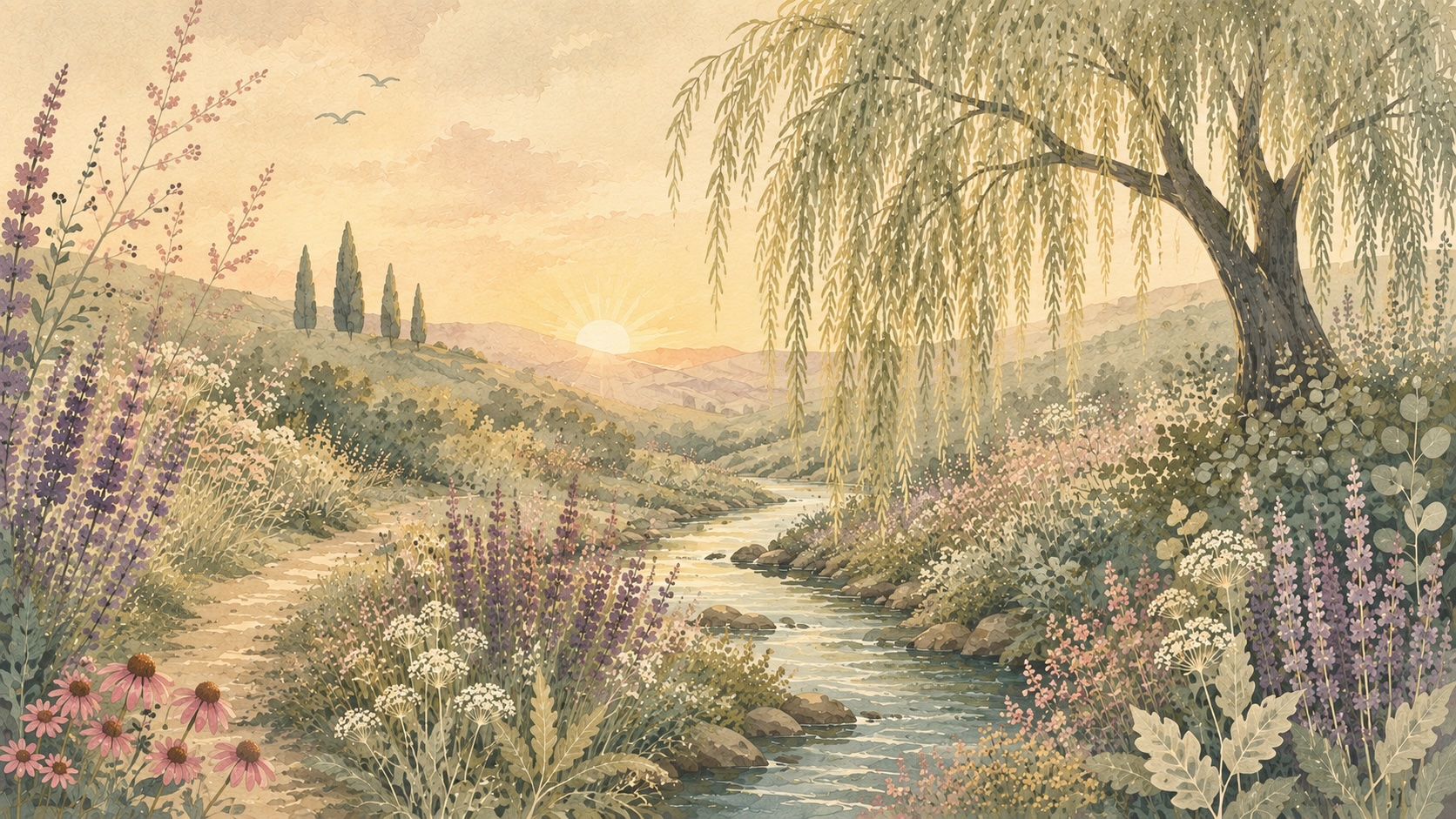
Willow was traditionally used for pain and fever long before its compounds became part of the story that eventually led to aspirin. Lavender also has a long history of traditional use, including for relieving mild symptoms of mental stress and exhaustion and helping to support sleep.
Ancient medicine also recognised the body’s inherent capacity for healing. This idea is captured in vis medicatrix naturae — the healing power of nature — an understanding of the body’s inherent tendency towards repair and restoration.
Our Changing Relationship with Healing
Somewhere along the way, our relationship with healing changed.
As our understanding of medicine developed, healthcare became increasingly specialised. Knowledge that had once formed part of everyday life gradually moved into the hands of professionals, institutions and an expanding pharmaceutical industry.
And with that came a subtle change in our own role.
We became increasingly accustomed to looking outside ourselves when something felt wrong. A symptom appears and our first response can easily be to ask: What can I take for this? What will make it go away? Who can fix it?
A pill can offer a much simpler answer than asking whether something in our diet, movement, sleep, environment or way of living might also be asking for our attention.
Over time, many of us have forgotten the role we can play in our own healing.
This is about remembering that receiving support and actively participating in our own health can exist together.
Because somewhere within this changing relationship with health, we began to outsource our own power.
We became less accustomed to seeing ourselves as active participants in our wellbeing and more accustomed to looking outside ourselves for the answers. We learned to hand over the problem and wait for the solution.
Yet throughout all of this, something remarkable remained unchanged.
The Intelligence Within
The body never stopped doing what it has always done.
Every moment of every day, your body is working on your behalf. It regulates your temperature, maintains the delicate balance of fluids and nutrients within you, responds to changes in your environment and continually repairs and renews itself.
When you cut your skin, you don’t have to tell the wound how to close. An intricate sequence of processes begins automatically. When your body encounters an infection, your immune system responds. Damaged tissues begin processes of repair and renewal, while countless internal systems continually adjust to maintain the conditions that support life.
Most of this happens without any conscious instruction from us.
There is something extraordinary about recognising this: healing isn’t foreign to the body. It is part of what the body does.
Our opportunity is to consider how we support it.
Food provides the energy and nutrients our bodies need, while periods without food have also formed part of health and spiritual traditions for thousands of years. For some, fasting can be a valuable practice. During periods of fasting, the body moves into a different metabolic state, drawing increasingly on stored energy and activating processes associated with cellular maintenance, renewal and adaptation. Rather than requiring a constant supply of food, our bodies are also remarkably adapted to periods of rest from eating. Hydration, movement, sleep and rest all contribute in different ways to the conditions in which our bodies carry out their remarkable work.
And there is no single formula that looks exactly the same for everyone.
We can begin developing a deeper relationship with our own bodies: noticing how we feel, recognising what gives us energy and what leaves us depleted, and becoming curious about the signals our bodies give us.
Perhaps something in the way we are eating, moving or resting is asking for our attention. Perhaps something in the way we are living is ready to change. Perhaps a persistent signal is guiding us towards support.
This is where we begin to move from simply having a body to being in relationship with our body.
And there is another important part of this relationship.
Because the environment in which our body is trying to heal isn’t only physical.
What Lies Beneath
We already recognise this to some extent through what we commonly call stress. We know that prolonged stress can affect us physically. We may feel it through changes in our sleep, digestion, breathing, energy or the tension we carry in our bodies.
Yet perhaps stress has become a word we use to describe something much wider and more complex.
Within The Empowr Method, we look more deeply at the underlying energies that can shape the way we experience ourselves, our lives and our wellbeing.
We may carry the energetic imprint of experiences that haven’t yet been fully processed. There may be emotions we have held onto, beliefs about ourselves that have shaped the way we live, repeating patterns, or relationships and environments that continually affect our energy.
These underlying energies can influence our mental and emotional experience, and we also recognise their relationship with our physical wellbeing.
This is why healing asks us to consider ourselves as a whole.
Our bodies aren’t collections of separate parts operating independently. We are extraordinary interconnected systems. Our physical, mental, emotional and energetic experiences exist in continual relationship with one another.
This invites us to look beneath what appears on the surface. What are we carrying? What is asking for our attention? Where does our energy feel depleted or constricted? What might be ready to change, move or transform?
This deeper exploration forms an important part of The Empowr Method. As we become aware of the underlying energies shaping our experience, we create space for greater movement, balance and flow across mind, body and spirit.
Finding Our Own Balance
Seeing ourselves as a whole also invites us beyond the divide between what is labelled mainstream and alternative healthcare.
Health isn’t about choosing a camp.
It is about considering everything that may be contributing to our wellbeing and finding the balance that is right for us.
There may be moments when we feel guided towards a doctor, practitioner, treatment or medicine. At other times, our attention may be drawn towards nutrition, movement, rest, fasting, a traditional practice or the wisdom of plants. And sometimes the invitation may be to look more deeply at the emotional or energetic patterns beneath what we are experiencing.
Each can have its place within the wider picture.
Instead of asking Which side is right?, perhaps a more empowering question is:
What does my whole being need?
Becoming Empowered in Our Health
We are living at a time of increasing diagnoses, with many people taking an increasing number of medications to manage different aspects of their health.
We are clearly facing significant challenges around health.
And perhaps beneath this health crisis there is also an empowerment crisis.
Perhaps this is the moment to reclaim our role.
To become more empowered in our own health journeys. To develop a deeper relationship with our bodies, tune into what they are communicating and notice where we are being guided.
That guidance will look different for each of us, and it may change at different moments in our lives. The invitation is to become increasingly attuned to what our bodies are communicating, to notice what supports our wellbeing and to remain open to where that inner guidance leads us.
The deeper wisdom lies in learning to listen, while gathering the support, knowledge and resources that are right for us.
Healing then becomes something we actively participate in.
We begin to understand our health as a relationship — one that asks for our attention, curiosity and care. We learn to consider ourselves as a whole and to seek balance across the many different elements that contribute to our wellbeing.
Perhaps this is what we are being asked to remember.
Your body has been communicating with you all along.
And the more deeply you tune in, the more empowered you can become in discovering what your own health journey is asking of you.
For you are the healer your body has been longing to reconnect with.
